Destination Wedding Room Block Contracts Explained: Deposits, Deadlines & Attrition
If you’ve never seen a destination wedding room block contract before, you’re definitely not alone.
Most of my couples haven’t.
And when I start talking about deposits, payment deadlines, room commitments, cancellation terms, and possible attrition, I can sometimes see the look that says:
Wait…I thought we were just reserving hotel rooms. 😅
You are.
But when you’re reserving rooms for an entire destination wedding group, there’s more happening behind the scenes than most couples realize.
Rooms may need to be held. Deposits may be due. Guest booking deadlines need to be established. Inventory needs to be monitored. And depending on the agreement, there may be important dates when rooms can be reduced or released.
The good news?
You don’t need to become a group travel expert just because you’re planning a destination wedding.
That’s my job.
So let’s break down how destination wedding room block contracts work, what deposits and deadlines can mean for your group, what attrition actually is, and why actively managing the room block matters long after the contract is signed.
Your Destination Wedding Room Block Is More Than a Group Rate

When I help a couple establish their destination wedding room block, we’re not simply asking a resort, “How much are your rooms?”
We’re creating an accommodation plan for an entire group of people.
Guests may travel on different dates.
They may stay for different lengths of time.
They may need different room categories.
And yes, someone will almost certainly change their plans along the way.
Your room block agreement may outline things such as the rooms being held, group rates, deposits, booking deadlines, cancellation policies, room commitments, and other terms your group needs to meet.
Those details matter.
Because once the agreement is signed, the room block isn’t something we stick in a folder and forget about until the wedding.
It needs to be managed.
If you’re still wondering what a room block is or how one gets established, start with Part 1: How Do Destination Wedding Room Blocks Work?
That guide walks you through the process from estimating your group to opening the room block for guests.
Now let’s talk about what happens after that.
How Many Rooms Should You Commit To?
Imagine you’re inviting 80 people to your destination wedding.
At first, everyone is excited.
“We’re coming!”
“Wouldn’t miss it!”
“Start making the margaritas!”
Then it’s time to actually book.
Suddenly, those 80 enthusiastic guests don’t necessarily turn into 40 booked rooms.
Someone can’t get the time off work.
Another guest’s budget changes.
A family situation comes up.
Someone who planned to bring a guest is now traveling alone.
That’s normal.
It’s also why I don’t simply look at an invitation list, divide it by two, and call that the room-block strategy.
When we’re establishing a room block, I’m looking at the actual group.
Who is realistically likely to travel?
How long might they stay?
What room categories will they need?
Are families attending?
What price points make sense?
What level of room commitment is appropriate for the particular agreement?
The goal isn’t to hold the largest number of rooms possible.
It’s to create a block that gives your guests appropriate options without taking on unnecessary commitments.
Why Your Guest “Book By” Date Matters
Every destination wedding group has one.
The guest who waits until the VERY last minute to book.
And for reasons science has yet to explain, there’s a suspiciously good chance it’ll be the best man. 😂
This is one reason I establish a Book By date for guests.
That deadline isn’t randomly chosen because it looks nice on the wedding website.
I look at the contractual deadlines for the room block and work backward.
If there’s an important date for reducing rooms, making an additional deposit, or meeting another requirement, I don’t want 20 guests deciding whether they’re coming at 11:57 p.m. the night before.
We need time to see where the group stands and take action before an important contractual deadline passes.
Your guests may simply see:
Please book your room by June 15.
Behind the scenes, there’s a reason June 15 was chosen.
That’s part of managing a destination wedding group strategically.
What Happens If Your Destination Wedding Room Block Doesn’t Fill?

This is usually one of the first questions couples ask once we start talking about contracts.
“What happens if we hold 30 rooms and only 20 get booked?”
My answer?
Let’s look at the contract.
Because there isn’t one universal answer.
Some agreements may allow unused inventory to be reduced by certain dates.
Some may have minimum room or room-night requirements.
Others may include attrition provisions that could create financial responsibility if the group falls below an agreed-upon amount.
And not every destination wedding room block agreement works the same way.
That’s why I don’t want my couples choosing between room blocks based solely on which resort offered a room for $20 less per night.
I want to understand what’s behind that rate.
How much inventory are we committing to?
When can rooms be reduced?
What happens if fewer guests travel than expected?
What deposit is required?
How does that deposit work?
What are the cancellation terms?
Those answers may ultimately matter far more than a small difference in the nightly room rate.
What Is Attrition in a Destination Wedding Room Block?
Attrition is one of those words you probably never expected to care about until you started planning a destination wedding.
In simple terms, an attrition clause may require a group to fulfill a certain portion of its agreed-upon room or room-night commitment.
If the group falls below that amount, there could be a financial consequence depending on the terms of the agreement.
Does every destination wedding room block include attrition?
No.
Does every agreement calculate or handle it the same way?
Also no.
That’s why my job isn’t simply to tell a couple, “Don’t worry about attrition.”
My job is to understand what their specific agreement requires, monitor how the group is booking, and pay attention to the deadlines that affect the block.
Setting up the rooms is step one.
Managing them is what happens during all those months between signing the agreement and boarding the plane.
Destination Wedding Room Blocks Can Have a Lot of Deadlines

This may be one of the least glamorous parts of destination wedding planning.
Your agreement may contain dates related to deposits, room reductions, guest payments, final balances, or other requirements.
Those dates matter.
That’s why I track them.
I also establish guest booking deadlines with the room-block timeline in mind.
As the wedding gets closer, I’m monitoring questions such as:
Are guests booking at the pace we expected?
Are certain room categories filling quickly?
Is unused inventory sitting in the block?
Are important payment or contract deadlines approaching?
Do we need to take action before one arrives?
My couples already have enough dates to remember.
Dress fittings.
Vendor payments.
Invitations.
Showers.
Bachelor and bachelorette trips.
Marriage-license requirements.
They don’t need to wake up at 2 a.m. thinking:
Wait…weren’t we supposed to release some of those rooms today?
What Happens When Guests Change Their Travel Plans?
Here’s something you learn very quickly when you manage destination wedding groups:
Travel plans change.
A guest originally books Wednesday through Sunday.
Then flights are released and they discover arriving Tuesday gives them a much better itinerary.
Now they want another night.
Another guest decides to turn the wedding into a full vacation and stay three extra days.
Someone needs to change roommates.
Another guest suddenly can’t travel at all.
And when I’m managing the travel, who gets those questions?
Me.
Not the couple.
That’s a bigger benefit than many couples realize when they first start planning.
You don’t want to spend the final weeks before your wedding answering messages from Cousin Amy because she found a better flight and wants to know whether she can add Thursday night to her reservation.
That’s exactly the kind of thing I want my couples to hand off.
We’ll talk much more about guest reservations and booking issues in Part 3 of this series.
For now, remember this:
Your room block isn’t static.
It changes as your guests’ plans change.
Your Guests Need to Understand Their Booking Terms Too
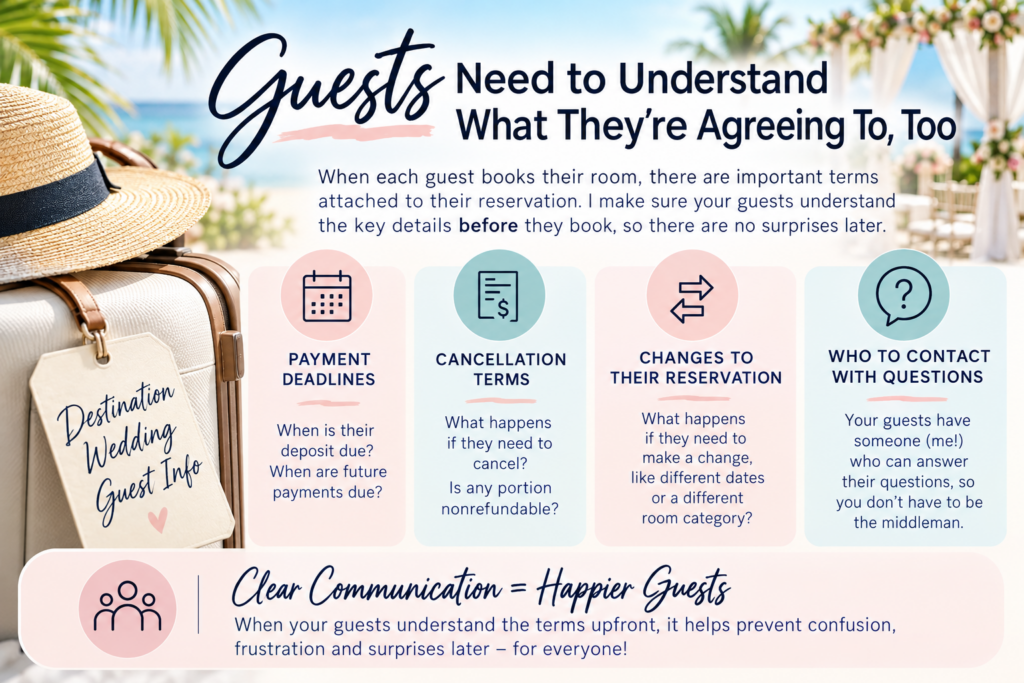
The couple isn’t the only one dealing with terms and conditions.
When guests reserve their rooms, they should understand the important terms associated with their individual booking.
When is payment due?
What happens if they cancel?
Is any portion nonrefundable?
What happens if they need to change their reservation?
I don’t want a guest discovering the cancellation terms for the first time after they’ve decided to cancel.
Clear communication at the beginning can prevent a lot of frustration later.
And instead of the couple becoming the middleman between dozens of guests and all those travel details, guests have someone they can contact directly.
What If Your Destination Wedding Room Block Fills Up?
Of course, there’s another possible problem:
Everybody starts booking.
Great problem, right?
Usually, yes.
But a full room block doesn’t necessarily mean we can snap our fingers and add another 15 rooms.
Additional rooms and specific room categories are generally subject to availability.
If I notice one category filling quickly or the group booking faster than anticipated, I can look at the available options and potentially request more inventory while it’s still available.
Again, that’s why monitoring the block matters.
We don’t want to realize three months later that the original block filled—and now the room category everyone wants is sold out.
Your Room Block Contract May Include Group Benefits
Room block agreements aren’t only about deadlines and obligations.
Depending on the resort and agreement, your group may also have opportunities to earn certain concessions or benefits.
These might include things such as complimentary room nights, upgrades, resort credits, or other group incentives.
But here’s the important part:
Understand how those benefits are earned.
They may depend on the number of rooms booked, total room nights traveled, minimum stays, or other requirements.
I don’t want couples building their wedding budget around a benefit they think they’re receiving without first understanding what the group needs to do to qualify for it.
So once again…
We look at the contract. 😉
So, Are Destination Wedding Room Block Contracts Complicated?

They don’t have to feel complicated to you.
That’s an important distinction.
Yes, there are contracts.
There are deposits and deadlines.
There may be attrition or minimum commitments.
There are guest payments, room categories, reservation changes, and plenty of moving pieces.
And yes, there will probably still be one person who waits until after the Book By date to finally reserve their room.
But this is exactly why destination wedding travel specialists exist.
I don’t expect my couples to become group-travel experts just because they’re getting married somewhere beautiful.
My job is to understand the travel side of the wedding so they don’t have to manage it themselves.
I help establish the room block.
I help couples understand the terms they’re agreeing to.
I help determine guest booking deadlines based on those terms.
I monitor important dates and room inventory.
I assist guests with reservation questions and travel changes.
And when someone discovers a better flight and wants to adjust their travel dates?
They contact me.
That’s the point.
A well-managed destination wedding room block isn’t about handing a couple a contract and a giant list of deadlines to remember.
It’s about creating a structure for the group—and having someone watch all those moving pieces while the couple focuses on their wedding.
Because during the week of your destination wedding, you should be wondering whether the weather will cooperate for your beach ceremony.
Not whether the best man ever paid his room balance.
Although, between us…
It’s probably the best man. 😏
You Don’t Have to Manage Your Destination Wedding Room Block Yourself
Could you learn all the ins and outs of destination wedding room block contracts yourself?
Probably.
But do you really want to spend the months leading up to your wedding tracking room inventory, watching contractual deadlines, answering guest questions, and figuring out what happens every time someone’s travel plans change?
Probably not.
You don’t need to become a group travel expert just because you’re getting married somewhere beautiful.
That’s where I come in.
You focus on the celebration.
I’ll help keep an eye on the travel details happening behind the scenes.
And yes…I’ll even deal with the best man who still hasn’t booked. 😉
Ready to start planning your destination wedding? Schedule a complimentary destination wedding consultation.
We’ll talk about your wedding vision, guest needs, budget, and priorities—and start narrowing down destinations, resorts, and a room block strategy that makes sense for your group.